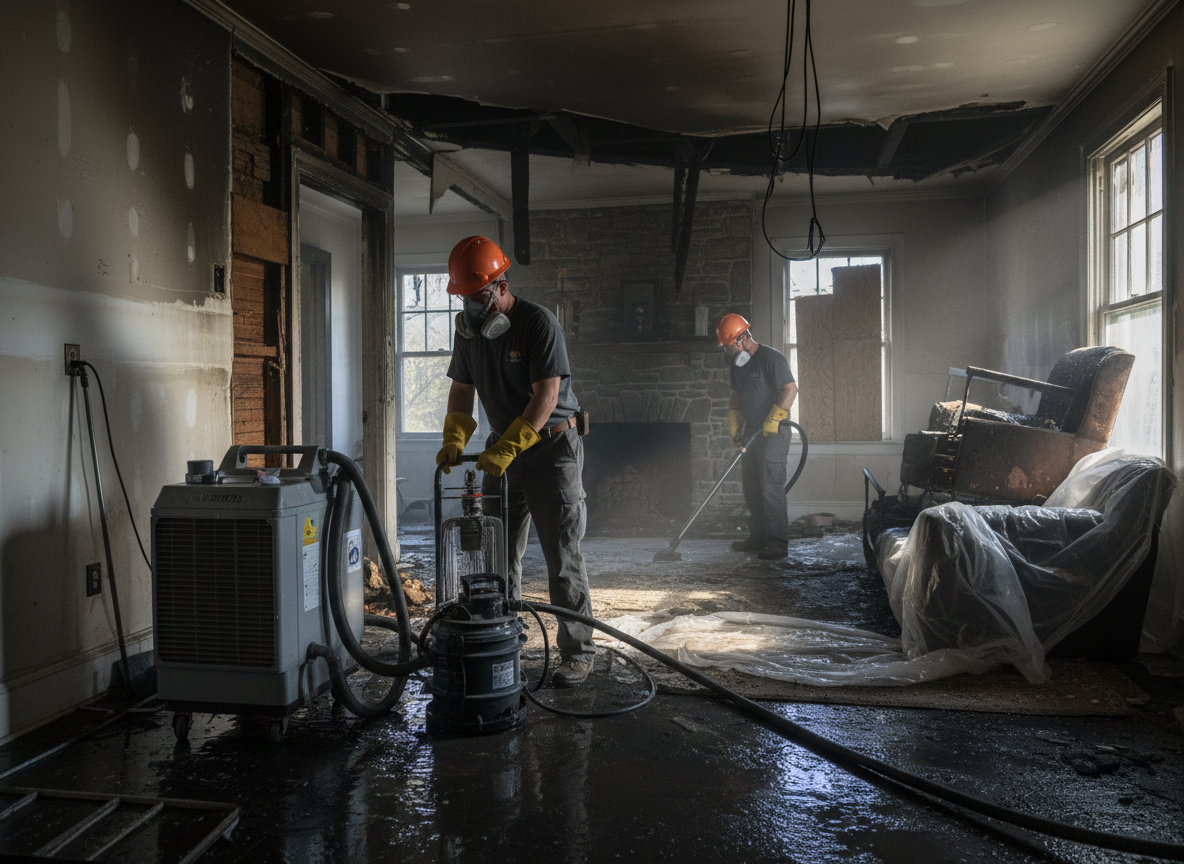
Bryn Mawr homes built before 1960 often feature plaster-and-lath walls and raised foundations that trap soot deep in cavities while also holding water from hose lines. When a kitchen or electrical fire occurs, suppression water soaks into these materials and the underlying soil, which stays damp longer because of the area's clay-heavy ground. Failure to pull baseboards and drill weep holes early lets hidden moisture migrate into adjacent rooms and trigger mold within days.
Flash flooding after the first winter rains can push ash-laden runoff under doors and into crawl spaces along Juanita Street and nearby blocks. The alkaline residue from burned structures changes the pH of standing water, corroding copper pipes and electrical boxes faster than clean floodwater would. Technicians must neutralize surfaces before drying or the corrosion continues behind new drywall.
Combined fire-and-flood jobs require staged drying: first remove loose soot with negative-air machines, then extract water, then run low-grain dehumidifiers for an extended period. Rushing the sequence leaves microscopic particles that later stain new paint or carpet. Local code requires permits for any structural tear-out exceeding ten percent of a wall in older homes, so documentation starts on day one.
Technician insight
In Bryn Mawr the thing that catches most people out with fire and flood restoration is how the clay soil along Juanita Street holds alkaline ash water under the slab for weeks, so even a small kitchen fire can turn into long-term subfloor damage if you only dry from above.
Kitchen Fire with Hose Water on Juanita Street
A single-story home near the shop suffered a stove fire that spread smoke through the kitchen and dining room. Firefighters' water pooled under the raised floor and wicked into the plaster walls. We removed baseboards, extracted water, treated for alkaline residue, and dried the cavities over seven days before rebuilding.
How it works
- 1
Emergency Dispatch
Technician arrives from the Juanita Street base within hours, secures the structure, and prevents further water or soot migration.
- 2
Detailed Assessment
Moisture meters and thermal imaging locate hidden water behind walls and under floors while noting smoke penetration depth in plaster and insulation.
- 3
Water Extraction and Soot Removal
Pumps and air movers pull standing water; HEPA negative air machines capture loose particles before demolition begins.
- 4
Drying, Cleaning and Restoration
Controlled drying continues until readings match unaffected areas, followed by antimicrobial treatment, odor neutralization, and rebuild to pre-loss condition.
Pricing
Upfront written estimates provided after inspection; final cost depends on square footage affected, materials involved, and drying time required.